
StrangerTest

Sample report

What a StrangerTest report looks like

A worked example on a fictional product, including the part most tools leave out: what we decided not to count, and why.

Fictional controlled example

Harborlight is a fictional company. We operate its website at fixture.strangertest.app as a stable, safe target for testing. The finding below is true of that site and you can check it there. The users, their words and the excluded observations are written to show how a real report is structured and judged; this is not the recorded output of a scan, and no real customer’s product or report is shown.

Free Scan · fixture.strangertest.app3 users

What StrangerTest found

3 users tested your product

Two of three users came wanting to try Harborlight, and neither could find a way to start the free trial the pricing page promises: every plan’s button leads to an email address. The third user came to check whether partial and bundled payments are supported, found the answer, and left satisfied.

The users

  • Finance lead comparing reconciliation tools

    Came to: Find out whether she can try Harborlight on her own statements this week.

    How it ended: Left from the contact section, saying she wasn’t going to email someone to start a trial.

  • Controller at a 60-person company

    Came to: Check whether Harborlight handles partial and bundled payments.

    How it ended: Found it on the Features page and on the Team plan. Stopped, saying she had what she came for.

  • Operations manager at an online retailer

    Came to: Work out which plan fits about 2,000 transactions a month, and how to start.

    How it ended: Identified the Team plan. Stopped, saying she couldn’t see how to begin the free trial.

ImportantObserved by 2 of 3 users · Repeated independentlyPricing and trial

The free trial the pricing page promises has no way to start it

Both users who came to try Harborlight read the pricing FAQ — “Every plan starts with 14 days free” — and looked for a way to begin. Every plan’s button reads “Contact us” and leads to an email address on the About page. Neither found a signup or trial path. One left; the other concluded a trial means emailing sales.

Why it mattersA visitor ready to try the product today meets a sales step instead. The promise of a no-card trial raises exactly the expectation the page then doesn’t meet.
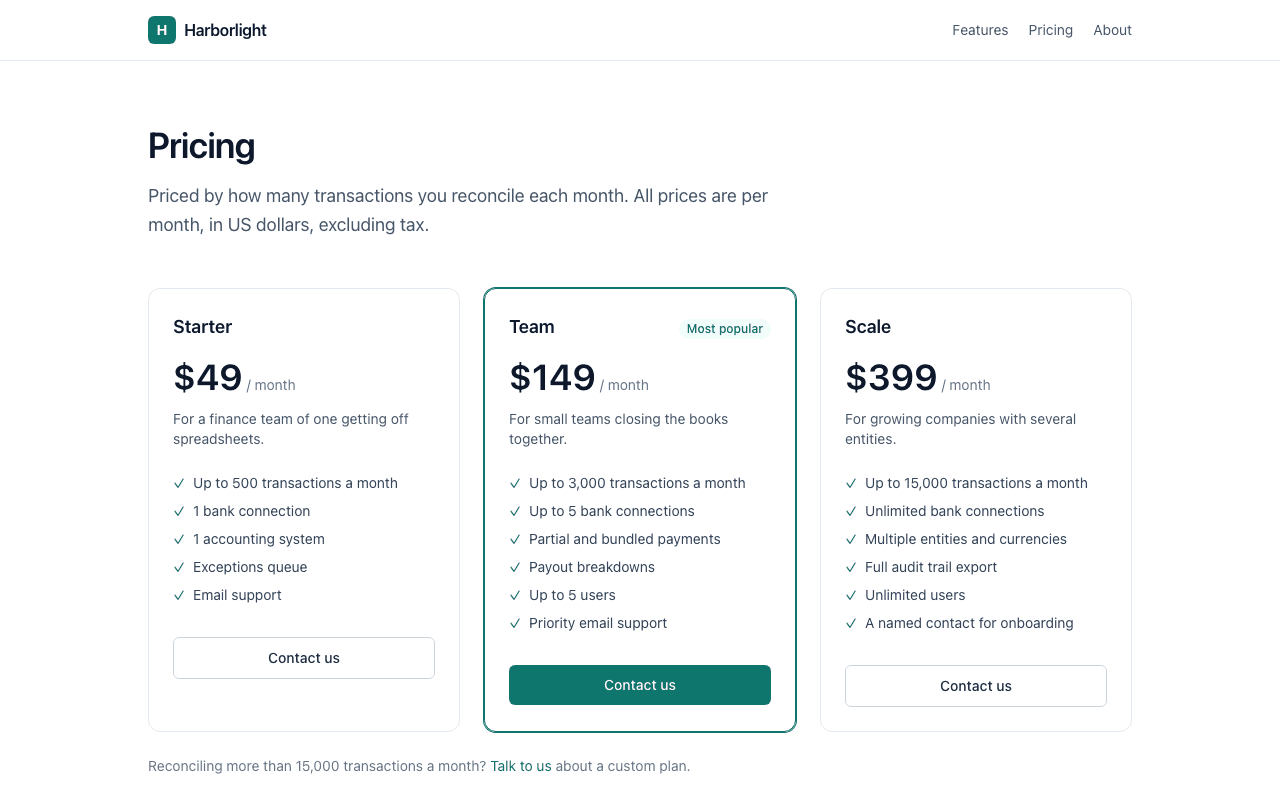
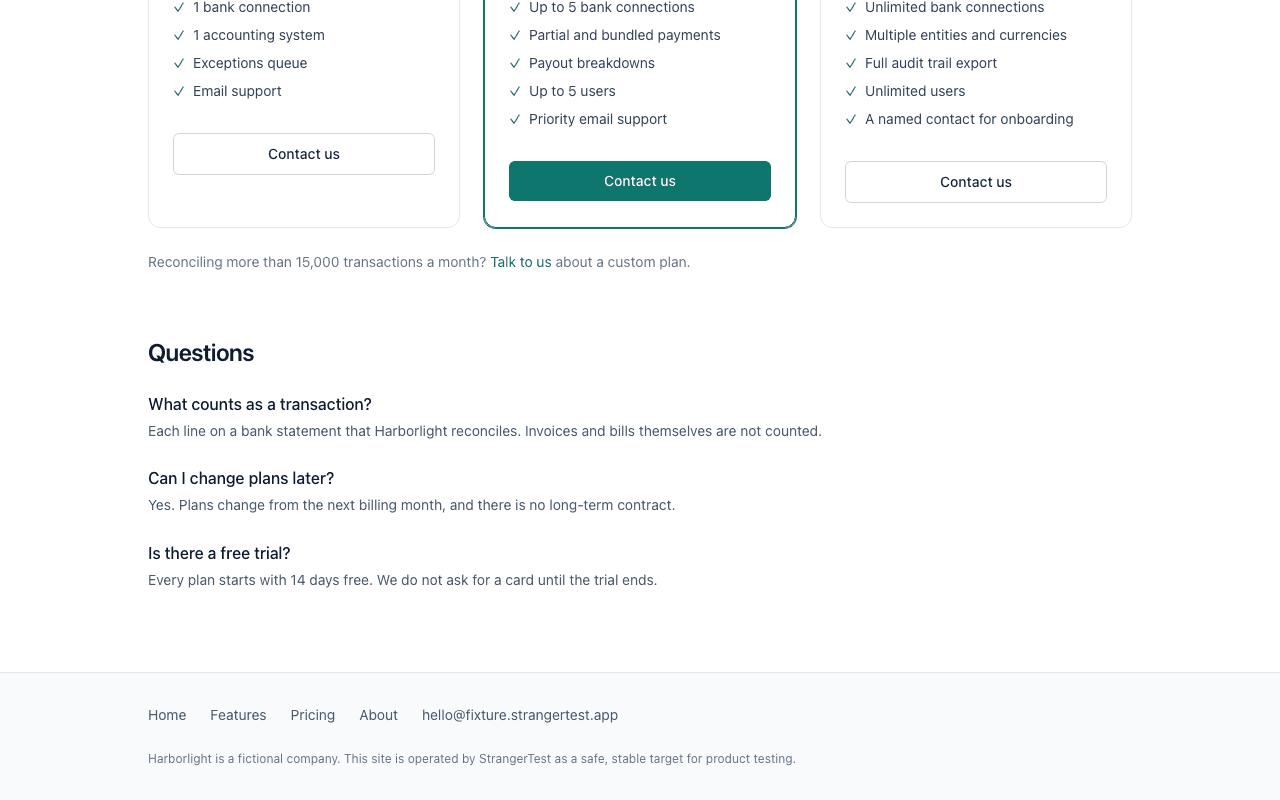
Harborlight pricing page: three plans, each with a Contact us button
Every plan: “Contact us”
Harborlight pricing FAQ: Is there a free trial? Every plan starts with 14 days free.
The same page: “Every plan starts with 14 days free”

Screenshots of the Harborlight site, taken for this page.

In their words

“It says fourteen days free, but every button just says Contact us. I was ready to try it on last month’s statements — I’m not emailing someone to find out how.”

Finance lead comparing reconciliation tools

What actually happened

Read the FAQ answer “Every plan starts with 14 days free.” Clicked “Contact us” on the Team plan. The browser went to the About page’s contact section, which shows an email address and no form or signup.

Finance lead · fixture.strangertest.app/pricing → /about#contact

Scrolled all three plans; each button reads “Contact us”. Read “Is there a free trial?”. Returned to the home page, whose buttons are “See pricing” and “How it works”. Chose to stop, saying she couldn’t see how to start the trial.

Operations manager · fixture.strangertest.app/pricing → /

In a Full Scan report, this finding also carries

What to change

Put a “Start 14-day free trial” action on each plan. If trials are sales-assisted, say so in the FAQ answer, so the promise and the path agree.

How you would know it worked

A first-time visitor who wants to try Harborlight reaches a trial signup from the pricing page without emailing anyone.

Plus a prompt to paste into your coding agent, and a re-test in which new users go back through this part of the product.

What we didn’t count

3 observations excluded as unreliable. These happened, and we decided they did not show a problem with your product. Listed so you can check that judgement.

“Compare plans” did nothing — likely automation artifact

Candidate observation: The controller clicked “Compare plans” on the Features page and reported that nothing happened.

Why we didn’t count it: The recorded before-and-after screens show the click landed below the button, on empty page space. Our execution layer missed its target, so this is evidence about our hand, not about your product. The button itself leads to the pricing page.

Security information is missing — insufficient evidence

Candidate observation: The operations manager typed /security into the address bar, received a 404, and said Harborlight has no security information.

Why we didn’t count it: The address was her guess, not a link on your site, so the 404 proves only that the guess was wrong. No user looked in the reasonable places and failed to find it; the contact section on the About page mentions security questions.

“I requested a trial” — insufficient evidence

Candidate observation: The finance lead’s closing takeaway began: “I requested a trial through the contact page.”

Why we didn’t count it: The browser record shows no form and no submission — the contact section is an email address, and our users never send email. The claim was not quoted and does not support any finding. Her reaction to being asked to email is kept.

Reading the report

What each part is for

What StrangerTest found says what happened in plain words, including when the honest answer is that nothing much went wrong.

Impact and evidence strength sit side by side and stay separate. “Important” is a judgement of what the problem costs; “observed by 2 of 3 users, repeated independently” is a count of what happened. A serious problem seen once is shown as seen once.

In their words contains only sentences a user actually wrote, after claims the browser record does not support have been removed. What actually happened is the record: the page, the action, the result.

What we didn’t count is where the evidence standard becomes visible. A missed click was our hand. A guessed address that 404s proves the guess was wrong. A claim to have done something the browser never recorded is not established. None of them is allowed to become a finding about your product, and all of them are shown so you can disagree.

How StrangerTest works

Run one on your own product.

Paste your product’s address. Three independent first-time users try it while you watch. Free, and no account.